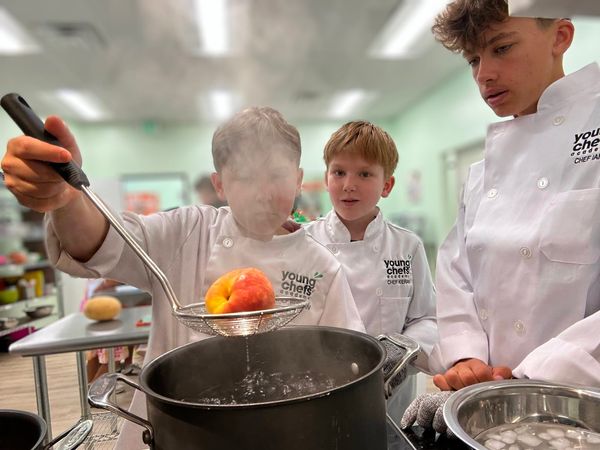
Young Chefs Academy operates cooking schools that offer weekly classes, birthday parties, summer camps, field trips, team-building events, and adult workshops. The physical model is built around one or two dedicated classroom spaces, and the concept scales around that classroom capacity.
There is a certain kind of franchise that does not get enough attention from serious investors.
It is not the flashiest concept, it does not come with a famous national brand name, and it probably does not show up on the lists of the fastest-growing franchise systems in the country. But it serves a market that is durable, emotionally resonant, and largely immune to the disruption that keeps reshaping other sectors. Young Chefs Academy is that kind of franchise.
Founded in 2005 under the predecessor entity Young Chefs International, the brand has spent two decades building a footprint in a niche that keeps getting more valuable: culinary education for children, families, and adults. As of the close of 2025, the system had 30 active locations operating across 14 states, and the system has grown steadily for three consecutive years, adding one location in 2023, three in 2024, and three more in 2025. That is not explosive growth, but it is the kind of controlled, deliberate expansion that tends to protect franchisee quality over time.
What You Are Actually Buying
Young Chefs Academy operates cooking schools that offer weekly classes, birthday parties, summer camps, field trips, team-building events, and adult workshops. The physical model is built around one or two dedicated classroom spaces, and the concept scales around that classroom capacity. Most of the revenue comes from recurring weekly enrollment, which creates the kind of predictable cash flow that service businesses envy.
The total investment to open a single location ranges from roughly $238,000 to $563,000 depending on location, build-out costs, and market factors. The initial franchise fee is $50,000, with a $5,000 reduction available for honorably discharged veterans and first responders, which is a meaningful gesture from a brand that has been in the children's services space for twenty years. Multi-unit operators can develop two or three locations with reduced fees on the second and third units, with both additional units priced at $40,000 per location.
The ongoing fee structure is a 6% royalty on gross sales, a 2% advertising fee, and a flat $250 per month technology fee. That 8% combined rate is competitive within the children's enrichment category, and the flat technology fee is a detail worth noting because it does not scale against your revenue the way percentage-based fees do.
What the Numbers Actually Show
The 2026 Franchise Disclosure Document includes Item 19 financial performance data drawn from 26 franchised outlets that operated for the full 2025 calendar year. Across all 26 reporting locations, average annual gross sales came in at $266,024, with a median of $222,612. The top-performing location in the system reported $660,992 in gross sales for the year.
When you isolate the full-time dual-classroom operators, the picture improves considerably. The nine franchises in that category averaged $412,364 in annual gross sales. The top third of those operators averaged $575,939, with the highest performer in that group reaching $660,992. Those numbers are meaningful because they tell you what the model can do when it is sized and operated the way the brand intends.
On the margin side, full-time dual-classroom operators reported an average net profit margin of 22%, with payroll as the largest cost driver at 37% of gross sales and rent averaging 14%. Across the full system, the average net profit margin was 16% to 17%. For a brick-and-mortar children's enrichment concept, margins in that range are reasonable and reflect the labor intensity of running a hands-on instruction business well.
What You Should Know Before You Dig In
Transparency matters in franchise consulting, so I want to name a few things the FDD raises that prospective investors should examine carefully. The document's special risk disclosures flag that the franchisor's financial condition calls into question its ability to provide full support to franchisees, and that intangible assets represent a substantial portion of total assets. These are not automatic disqualifiers, but they are the kind of factors that warrant a close review of the financial statements in Item 21 and candid conversations with existing franchisees listed in Item 20.
The leadership team is also new. CEO Leigh Feldman came on board in May 2025, and most of the executive team joined in the same window. Jamie Skinner, the COO, has deep brand history as the former Vice President of Franchise Operations in Waco, and the Franchise Business Coaches are the McKelveys, a husband-and-wife ownership team out of Texas who have operated their own Young Chefs Academy locations since 2021. The operational wisdom is there. The stability of the new corporate structure is something worth validating with time and conversation.
Who This Is Built For
Young Chefs Academy fits a particular kind of investor: someone who wants to be in the children's enrichment space, values community presence and recurring revenue, and is comfortable with a hands-on, people-centered operation. This is not a passive investment or a semi-absentee model. The brand requires active owner engagement, strong local marketing, and the ability to build relationships with families, schools, and community organizations.
If that profile sounds familiar, it might be worth a conversation. I work with investors across a range of investment levels and life stages, and part of what I do is help people find the concept that fits not just their budget, but their strengths. Young Chefs Academy is a brand I am watching closely, and for the right investor in the right market, it may be exactly the opportunity that has been missing from your shortlist.
If shaping the next generation of young chefs resonates with the impact you want to make on your local community, the next step is to schedule a 20-minute Zoom meeting for an overview of the company, business model, economics, due diligence process and funding opportunities.
Will Huffhine is a business ownership strategist and founder of Quantum Franchise Group. He works with professionals exploring franchise ownership, business acquisition and entrepreneurship and leads a national team of franchise consultants.