Why 2026 Is More Favorable For New Business Creation
The Conditions Have Changed. Are You Paying Attention?

– 7 min read

The Conditions Have Changed. Are You Paying Attention?

I want to have a conversation with you that most people in my industry are not having yet. Not because the information isn’t available, but because the dots haven’t been connected in a way that actually means something to the person sitting on the fence about business ownership.
Here’s what I want you to understand: the structural environment for starting a business in 2026 is meaningfully better than it was in 2023 or 2024. Not marginally better. Measurably, specifically, demonstrably better. And if you have been waiting for the right conditions, the conditions have shifted in your favor in more ways than one.
Let me show you the data.
The Tax Picture Just Got a Lot Clearer
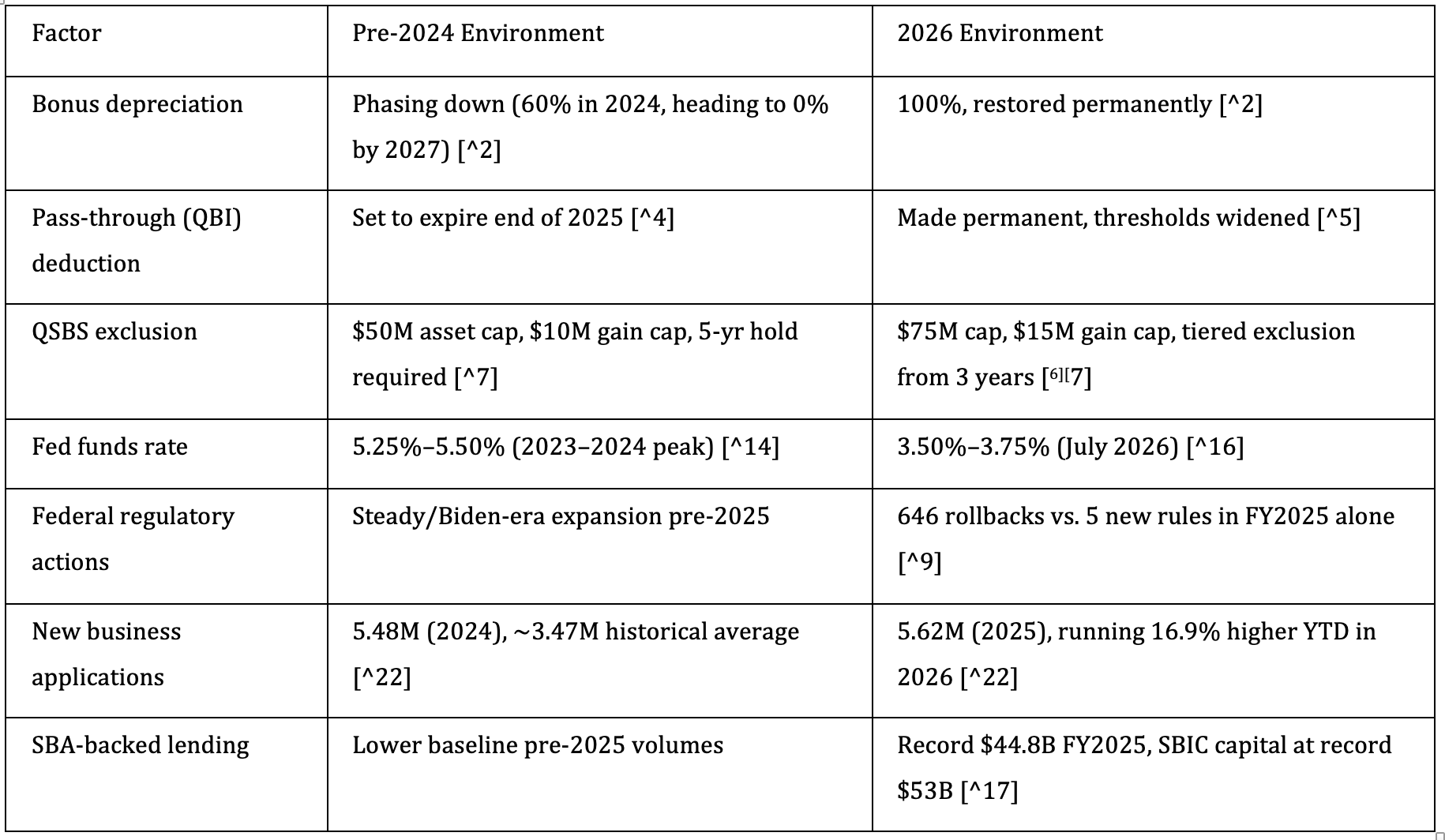
Before 2024, business owners and aspiring entrepreneurs were staring at what tax professionals called a “sunset cliff.” The Tax Cuts and Jobs Act provisions that had made business ownership more financially attractive were scheduled to expire at the end of 2025. Bonus depreciation, which allows business owners to immediately deduct large asset purchases, had already phased down to 60% in 2024 and was heading toward zero by 2027. The 20% pass-through deduction that benefits small business owners was set to disappear entirely. The uncertainty alone was a legitimate reason to pause.
That uncertainty is gone.
The One Big Beautiful Bill Act, signed into law on July 4, 2025, permanently extended and in many cases expanded these provisions.
These are not small adjustments. They are permanent structural changes that make the economics of business ownership better than they have been in years.
In 2025, 5.62 million new business applications were filed in the United States, up 8.2% from 5.48 million in 2024. Both figures dwarf the pre-2024 historical average of roughly 3.4 to 3.47 million applications per year.
The Regulatory Environment Is the Most Favorable in Decades
In January 2025, Executive Order 14192 directed federal agencies to repeal at least ten existing regulations for every new one issued. What happened next was remarkable by any historical standard.
In fiscal year 2025, federal agencies finalized 646 deregulatory actions against just 5 new regulatory actions, a ratio of 129 to 1, far exceeding the 10 to 1 target. The estimated savings from that single year of deregulation: $211.8 billion, more than in all four years of the previous Trump administration combined. The total number of final rules issued in 2025 came in at 2,441, the lowest count ever recorded. For 2026, an additional 702 rule rollbacks are in the pipeline, targeting a projected $1.5 trillion in economy-wide savings.
For small business owners, some of the most consequential changes have been direct compliance cost reductions. The repeal of FinCEN’s Beneficial Ownership Information reporting requirement alone is estimated to save $128.6 billion in compliance burden. These are real dollars, real hours, and real headaches that have been removed from the small business owner’s plate.
Money Is Cheaper Than It Was
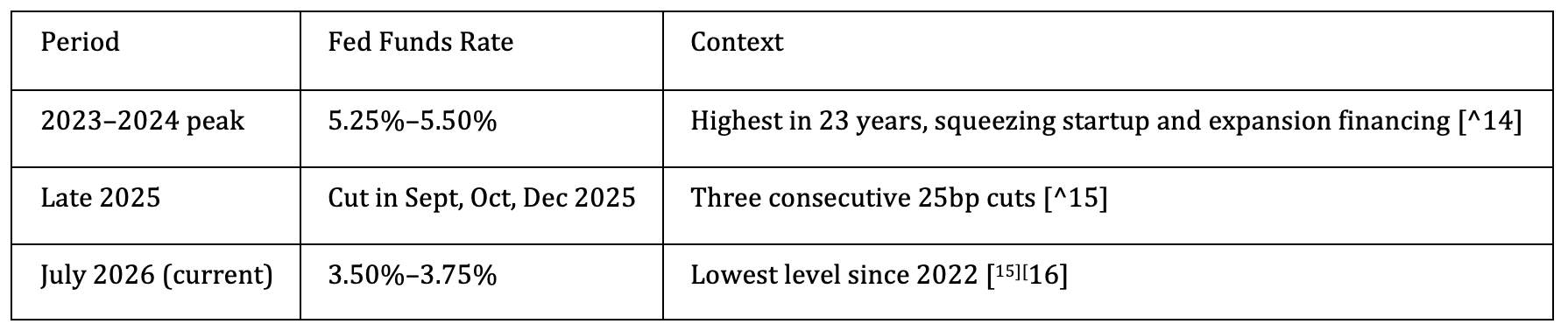
From 2023 through mid-2024, the Federal Reserve held rates at 5.25% to 5.50%, the highest level in 23 years. For anyone trying to finance a business purchase, fund startup costs, or carry equipment debt, those rates created real friction.
The rate environment today looks meaningfully different. Through three consecutive cuts in the fall and winter of 2025, the Fed brought rates to their current level of 3.50% to 3.75%, roughly 175 basis points below the peak. That decline translates directly into lower monthly payments on SBA loans, reduced cost of equipment financing, and more accessible credit lines for new business owners.
And the lending data confirms the shift. In fiscal year 2025, the SBA backed 84,400 loans worth a combined $44.8 billion across its 7(a) and 504 programs, a record. Private investment capital through SBIC programs reached $53 billion, also a record, up from $46 billion the prior year. In Q1 2026 alone, SBA 7(a) lending nearly doubled quarter over quarter to $8.49 billion as banks adjusted to the new policy environment. New programs specifically targeting small manufacturers, including the MARC revolving credit program with fee waivers through September 2026, have added further accessibility for entrepreneurs in physical product categories.
The Market Is Voting With Business Applications
Perhaps the most compelling evidence of where we are is the raw behavior of American entrepreneurs. In 2025, 5.62 million new business applications were filed in the United States, up 8.2% from 5.48 million in 2024. Both figures dwarf the pre-2024 historical average of roughly 3.4 to 3.47 million applications per year. Through the first half of 2026, applications are running 16.9% ahead of the same period in 2025.
That is not noise. That is a signal. People who are paying attention to the actual conditions are choosing to start businesses at a rate that has no modern precedent.
A Balanced Read
I want to be honest with you, because that’s what you deserve. The picture is not uniformly rosy. Inflation ticked back up to 3.5% to 4.2% in mid-2026, driven in part by tariff pressure. Small business sentiment has been choppy, with the NFIB Optimism Index dipping to 95.3 in May before rebounding to 97.4 in June. Tariff-related cost uncertainty is real for businesses that depend on imported inputs.
None of that changes the underlying structural case.
The Question Is Whether You Are
I am not in the business of telling people when to start a business. That decision belongs to you. But I am in the business of giving you the full picture so the decision is an informed one.
The conditions have shifted. The case for business ownership has not been this structurally strong in a very long time. If you have been waiting for the right environment, this is a serious candidate for that moment.
If you want to talk about what this looks like specifically for you, let’s have a zero-cost, no-obligation business startup call. My team and I have helped over 150 people open new businesses since 2022. Here’s a link to my calendar.

Will Huffhine is the President of Quantum Franchise Group. Schedule a conversation at acallwithwill.com.
References
1. One Big Beautiful Bill Act - Tax Changes for 2025 - Dean Dorton - The One Big Beautiful Bill Act signed on July 4, 2025 introduces sweeping legislative changes impact...
2. Small Business Legislation Benefits Both Businesses and Individuals - The Tax Cut and Jobs Act of 2017 offers additional tax breaks for both business owners and individua...
3. One Big Beautiful Bill Act - Wikipedia
4. US Small Business Optimism Lowest in 11 Months - The NFIB Small Business Optimism Index in the US fell to 95.8 points in March 2026, the lowest since...
5. The Section 199A QBI Deduction in 2026: A Permanent 20% Tax Break for Pass-Through Business Owners - OBBBA made the Section 199A pass-through deduction permanent and widened the 2026 phase-in to $201,7...
6. Qualified Small Business Stock (QSBS) Regime Expanded Under ... - Discover key changes to the Qualified Small Business Stock (QSBS) regime under the One Big Beautiful...
7. Qualified Small Business Stock (QSBS) – Post OBBBA - Discover how Qualified Small Business Stock (QSBS) under IRC Sec. 1202 can help you exclude capital ...
8. Executive Order 14192 - Unleashing Prosperity through ... - EO 14192 directs all agencies to repeal at least ten existing regulations for each new regulation is...
9. Showing the Trump Administration Has Best Deregulation Year in ... - Washington, D.C. -- Coming off of President Trump’s end-of-year speech on affordability and Making A...
10. Regulatory Reform Results for Fiscal Year 2025
11. Trump ramps up war on regulations with 702 cuts in pipeline - Trump administration proposes 702 regulatory cuts, targeting environmental reviews and efficiency st...
12. Trump administration targets 702 rules in $1.5T deregulatory plan - The 2026 regulatory plan targets 702 federal rules with a projected $1.5 trillion in cost savings, d...
13. Impact of Trump’s 646 deregulatory actions diluted by tariffs ... - President Trump’s efforts to cut Biden-era regulations are being eclipsed by his tariffs and other e...
14. FOMC’s target range for the federal funds rate - FOMC’s target range for the federal funds rate … 01/30/2025 4.25 4.5 03/20/2025 4.25 4.5 05/08/2025....
15. Fed Lowers Rates for 3rd Time - The Federal Reserve cut the federal funds rate by 25 bps to a range of 3.5%–3.75% in its December 20...
16. United States Fed Funds Interest Rate - The benchmark interest rate in the United States was last recorded at 3.75 percent. Rate Projection ...
17. New programs, fee changes and other SBA loan changes to expect in 2026
18. SBA 7(a) lending rebounds in Q1 2026 as banks adjust to policy ... - US banks logged $8.49 billion in gross approved Small Business Administration 7(a) loans in the firs...
19. Consumer prices up 2.4 percent over the year ended January 2026
20. Current U.S. Inflation Rates: 2000-2026 - The annual inflation rate in the United States was 3.5% for the 12 months ending June, down from 4.2...
21. Business Formation Statistics
22. New business statistics: 2005 to June 2026 - Finder - Ever wondered how many businesses launch in the US each year? Dive into the numbers, including month...
23. United States Nfib Business Optimism Index - The US NFIB Small Business Optimism Index increased to 97.4 in June 2026, the highest in four months...
24. U.S. NFIB Small Business Optimism Index (June 2026) - The NFIB’s Small Business Optimism Index rose 2.1 points to 97.4 in June, moving closer to its 52-ye...