AI Is a Great Starting Point for Franchise Research. It's a Terrible Finishing Point.

– 5 min read

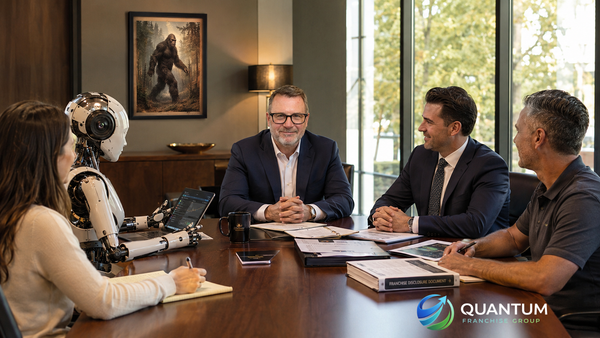
More and more of them are arriving at our first call with a head full of AI-generated research. They’ve asked ChatGPT or Claude or Gemini which franchises perform best in their market, what the average franchise investment looks like, what makes a good FDD, and which categories are recession-resistant. They arrive informed, engaged, and genuinely excited. They’ve done their homework.
And a surprising number of them have gotten things meaningfully wrong.
Not because they aren’t smart. They are. Not because AI is useless for this process. It isn’t. But because they’ve handed the entire research function to a tool that is excellent at some parts of this process and genuinely dangerous at others. And nobody told them there’s a difference.
This article is that conversation.
Franchise due diligence done right is not a single activity. It is a four-part process, each part serving a distinct purpose, each part depending on the others to be complete. When people skip steps, or collapse all four into one, the outcome suffers. Sometimes it suffers quietly. Sometimes it costs someone their life savings.
Here’s what the full process actually looks like.
Part One: AI for High-Level Orientation
This is where AI earns its place, and it earns it well. If you want to understand the difference between a brick-and-mortar franchise and a mobile service model, AI can explain it clearly. If you want a working definition of royalties, territory protection, or the purpose of a Franchise Disclosure Document, AI is an efficient and patient teacher. If you want to understand what industries tend to be recession-resistant, or get a general landscape of what categories exist across the 4,000-plus franchises currently operating in the United States, AI is a reasonable starting point.
What AI cannot reliably do is tell you which specific franchises are actually performing in your specific market right now, which brands have reputations that don’t match their marketing materials, or whether the financial performance data being cited is accurate, current, and properly contextualized. AI trains on public data. Much of what drives franchise success and failure lives in private conversations, unreleased FDD amendments, and the hard-won pattern recognition of people who work in this industry every day. AI doesn’t have access to that. It doesn’t know what it doesn’t know, and it won’t always tell you when it’s filling gaps with confident-sounding guesses.
Use AI to get oriented. Do not use it to make decisions.
Part Two: A Franchise Consultant to Interpret, Pressure-Test, and Guide
This is the step that most self-directed researchers skip entirely, and it is the most consequential step in the process.
A franchise consultant’s job is not to sell you a franchise. My job is to serve as your research expert, educator, coach, and advocate, with your best interests as the highest priority. That means taking what you’ve learned from your AI research and pressure-testing it against realities the AI cannot access. It means knowing which brands have strong validation communities and which ones produce franchisee complaints that never surface in public searches. It means understanding your market, your goals, your capital position, your personality, and your risk tolerance, and using all of that to narrow a field of more than 4,000 franchises down to eight or ten that are genuinely worth your time and attention.
There is also a practical reality about access that most people don’t know going in. Less than 40% of candidates who contact a franchisor on their own ever receive a call back. The franchise development teams at the best brands are selective about where they invest their time, and an unsolicited inquiry from an unknown candidate goes to the bottom of the list, if it gets responded to at all.
A franchise consultant changes that equation entirely. When I introduce a candidate to a brand I work with, that candidate is positioned as a high-priority referral. In most cases, they receive a call back within 24 to 48 hours. They enter the process at the top of the stack rather than the bottom of the inbox.
A consultant can also assist with funding strategies and connect you with qualified franchise attorneys for legal review. This is not a solo sport, and the best consultants function as a full-service bridge between where you are and where you want to go.
Part Three: The Formal Discovery Process With Franchisors
Once you’ve identified the eight to ten brands that best fit your profile, the real due diligence begins. This is an eight to twelve week process of structured calls, meetings, and document reviews, during which both you and the franchisor are mutually evaluating one another. Discovery Days, FDD reviews, territory analysis, financial modeling, conversations with the brand’s leadership team, and ultimately the decision of whether both parties want to enter into a franchise agreement.
This process is not something to navigate alone. Your consultant stays with you as a coach throughout, helping you ask the right questions, interpret what you’re hearing, and avoid the common mistakes that unsupported candidates make when they’re excited and eager and moving fast.
The FDD alone, the legal document that governs your entire relationship with the franchisor, is over 200 pages in most cases. How you read it and what you do with it matters enormously.
Part Four: Validation Calls With Existing Franchisees
The fourth and final piece is the one that AI can never replicate under any circumstances. Validation calls are direct conversations with people who are already operating inside the franchise systems you’re most excited about. They are the human truth-tellers in this process.
A well-run validation process tells you what the day-to-day reality of ownership actually looks like inside a specific system. It tells you whether the support the franchisor promises is the support franchisees actually receive. It tells you what the first year genuinely felt like, what they wish they had known, and whether, given everything, they would make the same decision again.
AI cannot simulate this. A brochure cannot simulate this. Only a real conversation with a real owner who has nothing to gain from misleading you can give you what validation calls provide.
The Bottom Line
AI is a tool. A useful one, at the right stage, for the right purposes. But franchise ownership is one of the most significant financial decisions most people will ever make, and it deserves a research process that matches the stakes.
Start with AI to get oriented. Then get a consultant in your corner to lead the way. Work through a rigorous discovery process with the brands that genuinely fit. And listen carefully to the owners who are already living what you’re considering.
That is how you make a great franchise decision. Not with a chatbot. With a complete process, properly executed, with the right people in your corner.
If you’ve done your AI research, I’m on deck to take you the rest of the way through the process. You can introduce yourself here.