How Can You Tell if a Franchise Is Actually Proven?
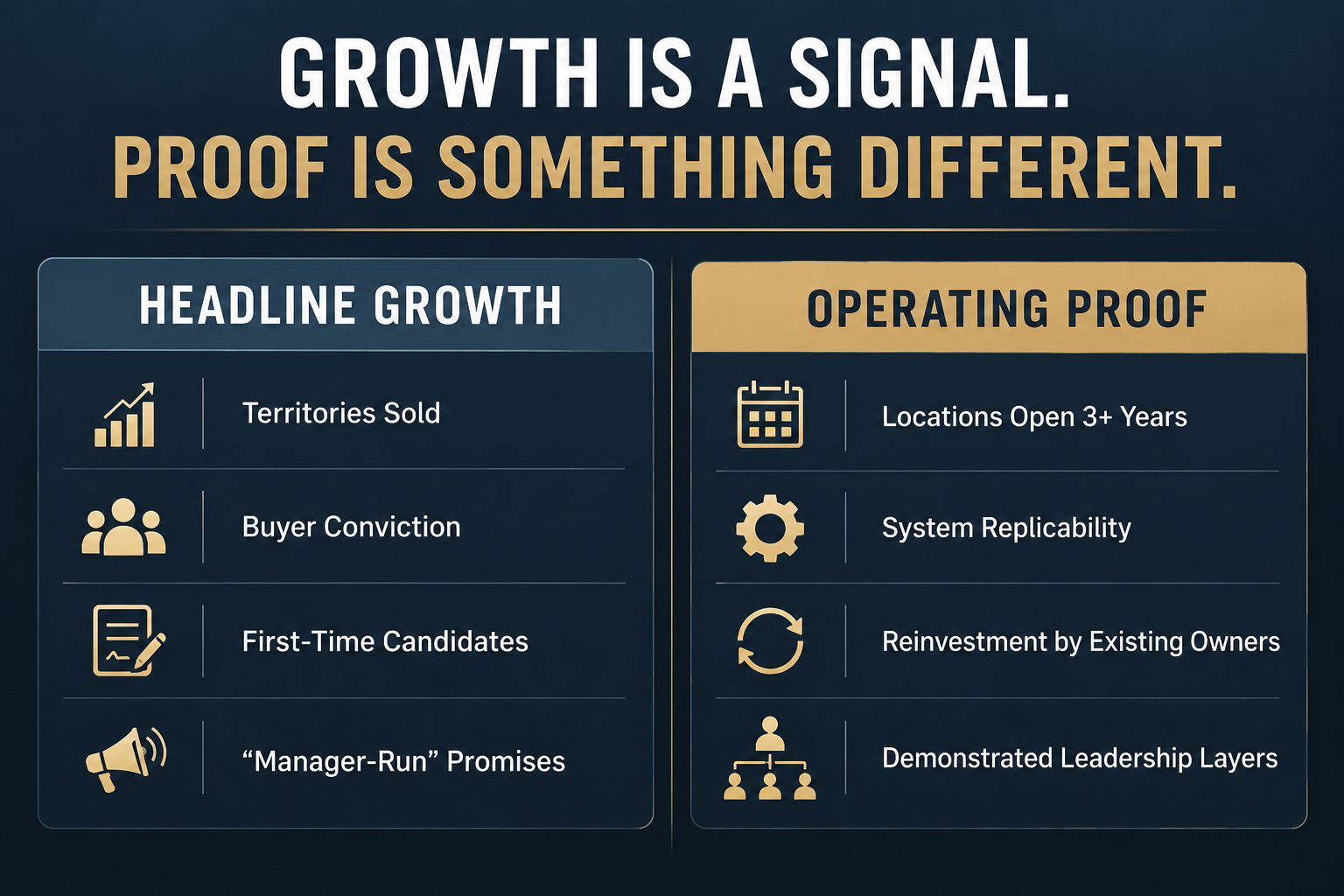
While numbers like "200 franchises awarded" sound exciting, true proof lies in how many locations are open, how long they have operated, whether independent owners successfully replicate the model, and whether existing franchisees choose to reinvest.
You can tell whether a franchise is genuinely proven by looking past its headline sales figures and evaluating the depth of its real-world operating evidence.
While numbers like "200 franchises awarded" sound exciting, true proof lies in how many locations are open, how long they have operated, whether independent owners successfully replicate the model, and whether existing franchisees choose to reinvest.
SPONSORED
Download the free Quantum Franchise Group publication, Why the Franchise Model is Exploding in the United States.
Early in my career, I found headline development numbers reassuring. I assumed that if hundreds of candidates were buying in, the concept was guaranteed to work. Today, after living through franchise ownership myself and advising corporate candidates, I know a fast-moving franchise sales engine can easily outpace the underlying operating model.
Properly evaluating a brand requires separating three distinct metrics: how fast the network grows, how much operating evidence exists, and what the owner's role becomes over time. A system can easily excel at selling territories long before proving that independent franchisees can run profitable, sustainable operations across diverse markets.
The Evidence Progression: Committed → Open → Seasoned → Replicated → Durable
To evaluate an opportunity systematically, I look at franchise evidence through a five-stage progression:
Committed: Has someone invested in the franchise? A signed agreement demonstrates buyer conviction, but it does not prove operating performance.
Open: Can the franchisor get franchisees into business? Opening a location proves launch execution, site selection, and initial setup.
Seasoned: What happens after the launch honeymoon? A location that has operated for three-plus years encounters ordinary friction like labor turnover, rising costs, local competition, and economic shifts. Time exposes a business to realities opening day cannot reveal.
Replicated: Can independent owners reproduce the results? Proof strengthens when successful operations appear across diverse franchisees and geographic markets, rather than staying concentrated in company-owned stores or a few star operators.
Durable: Does the system sustain itself long-term? This stage measures multi-year retention, owner reinvestment, unit economics, and whether franchisees can build organizations that function beyond their own daily labor.
This progression does not instantly label a franchise as "good" or "bad." Instead, it clarifies what has been proven versus what you are being asked to underwrite with your capital.
Item 20: Your Practical Evidence Source
Item 20 of the Franchise Disclosure Document (FDD) is your best tool for looking past marketing claims to see actual system movement. By analyzing multi-year patterns of openings, closures, terminations, transfers, and unopened awarded territories, you gain a transparent view of operational health.
If franchise sales are skyrocketing while location openings or owner retention rates stall, that gap warrants deep investigation. The goal is not to penalize growth, but to confirm that real-world operating footprints are expanding at the same pace as sales momentum.
Reinvestment by Existing Owners Is a Major Signal
First-time franchise buyers make decisions based on projections, validation calls, and enthusiasm. In contrast, existing franchisees considering an additional territory possess lived operational experience.
Current owners know the real margins, staffing headaches, and true level of franchisor support. When experienced operators who already understand the daily reality choose to cut another check, that reinvestment offers a far stronger signal of confidence than a brand-new candidate's initial purchase.
Similarly, strong company-owned locations prove baseline consumer demand, but corporate success and franchisee replication are different tests. Corporate units often operate with more capital and leadership bandwidth than an independent franchisee. You must verify that independent owners—operating with their own capital—can mirror those corporate results.
Seven Questions to Ask When a Franchise Is Growing Quickly
When a brand highlights rapid expansion, dig beneath the surface with these seven questions:
Does your reported unit count represent signed contracts, awarded territories, or fully operational locations?
How many independently owned locations are open right now, and how many have operated for more than one, two, and three years?
What do Item 20’s openings, closures, transfers, and terminations show over the last three to five years?
How many existing franchisees have chosen to invest in additional units or territories?
How consistently are your unit economics replicating across different geographic markets and independent operators?
What does the franchisee’s daily role look like after three years—are they still tied to daily tasks or leading a manager-run team?
What happens to franchisees who do not reach their projections, and how does the system support them?
Growth Is a Signal. Proof Is Something Different.
Rapid growth is exciting, but it only proves that a concept is easy to sell—not that the operating system is easy to run. Entering a younger system before it fully matures can offer prime territories and significant upside, provided you recognize the specific risks you are accepting.
The purpose of due diligence is never to eliminate uncertainty; it is to understand exactly which uncertainty you are paying to underwrite. Growth is a signal. Proof is something different.
Chris Tucker is a trained and certified franchise consultant as well as a former multi-unit franchise owner. Having experienced franchising from both sides, he's uniquely qualified to help you evaluate the strength of franchise systems.
Chris Tucker created The Corporate Refugee® and an ownership advisory methodology that helps professionals determine what they should build before deciding what they should buy. Franchise selection is one possible downstream application.