Should I Start a New Business or Buy an Existing Business?
There is no universally correct answer. Both paths have produced successful business owners and both have produced painful failures. What separates the outcomes is not the path, but the match with their capital position, their risk tolerance, their timeline, and their strengths.
The honest answer to this question is that it depends entirely on who you are, what you have, and what you are trying to build.
According to Will Huffhine, President of Quantum Franchise Group, there is no universally correct answer. Both paths have produced successful business owners and both have produced painful failures. What separates the outcomes is not which path someone chose but whether the path they chose matched their capital position, their risk tolerance, their timeline, and their operational strengths. This article will walk you through both options clearly and honestly so you can make an informed decision rather than an emotional one.
Starting a Business From Scratch: What It Actually Looks Like
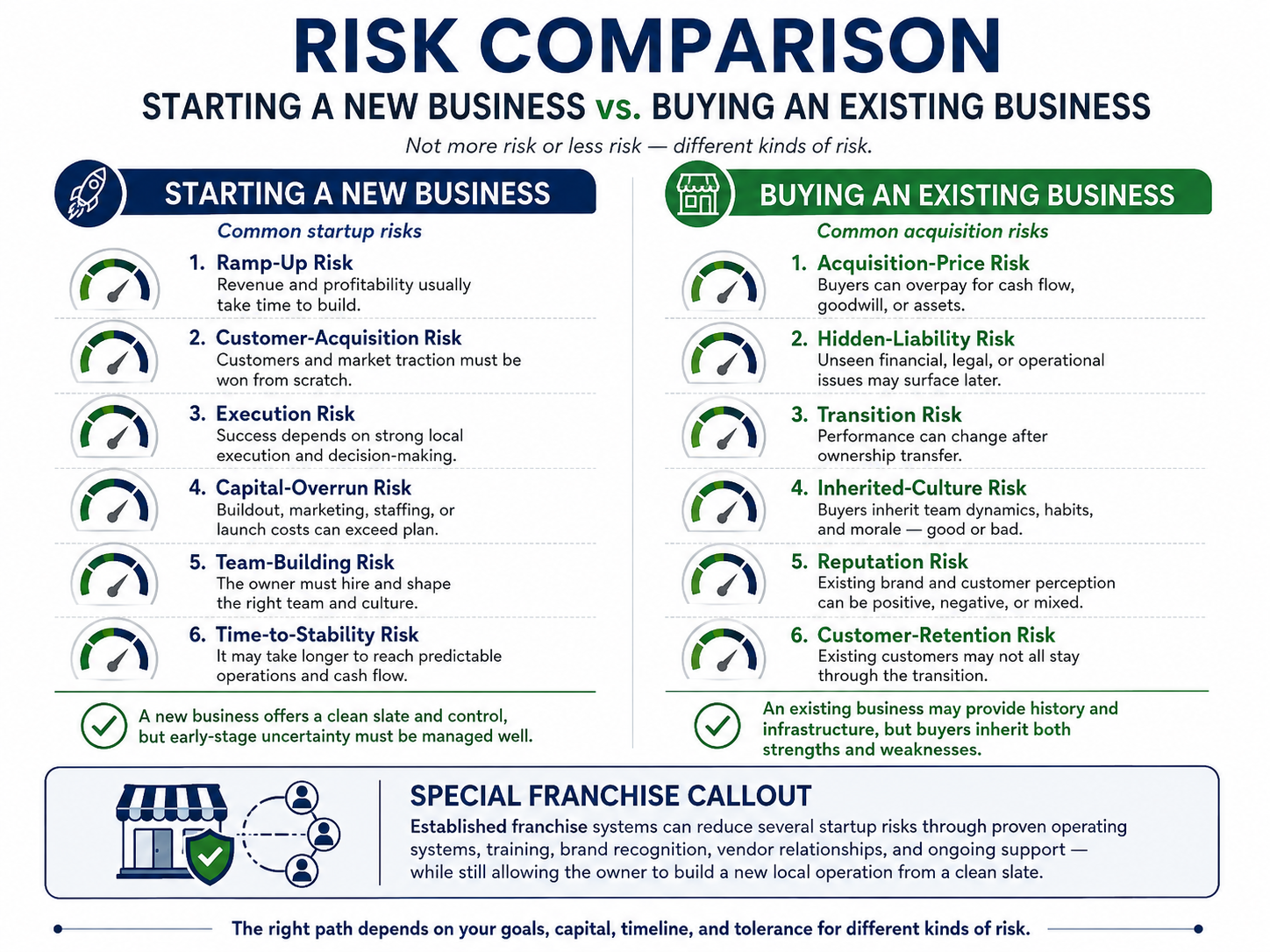
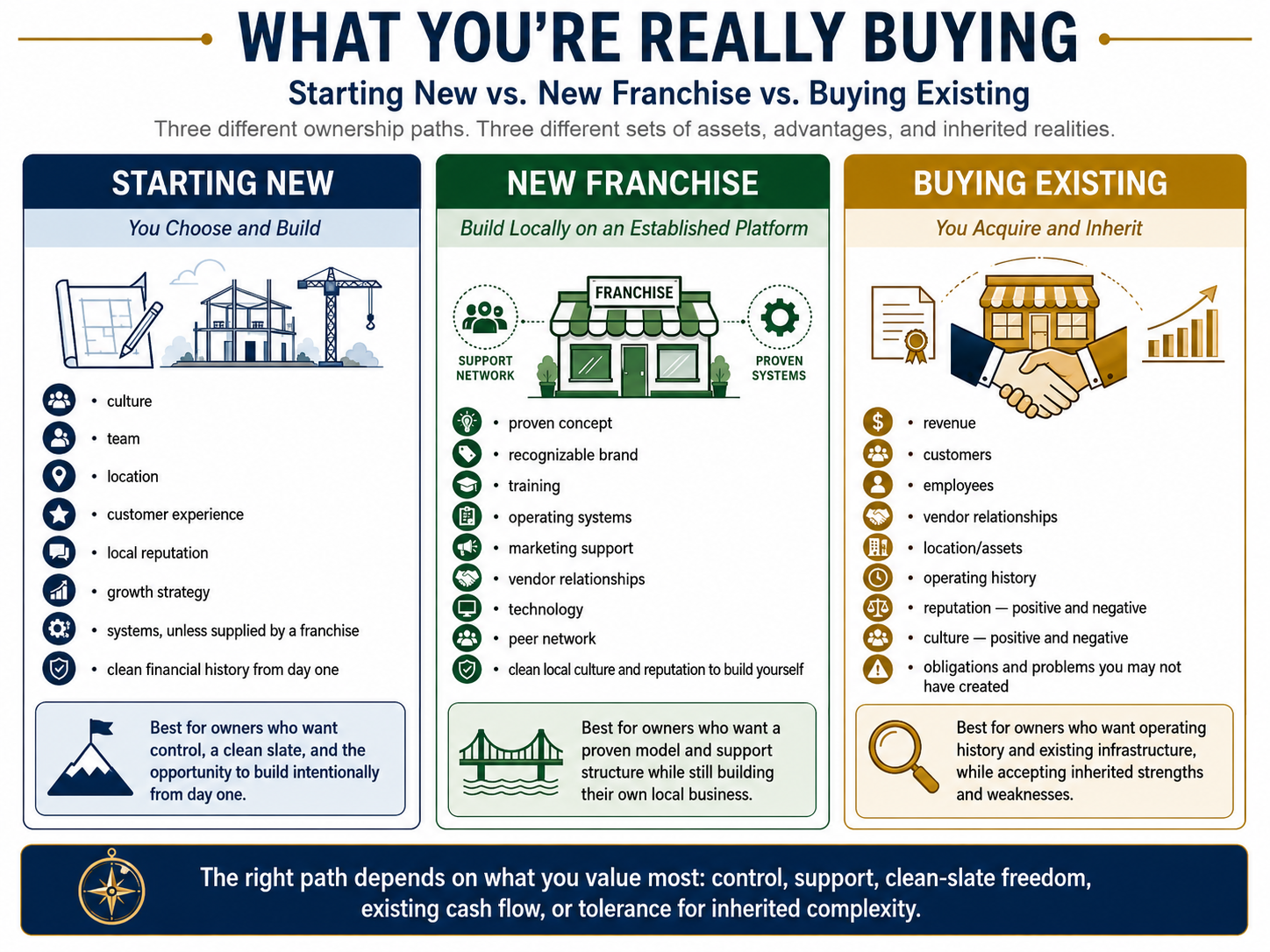
Starting a business from zero means you are building every element of the operation yourself. The brand, the processes, the customer acquisition strategy, the team, the supplier relationships, the reputation. Nothing exists until you create it.
The appeal is significant and real. You have complete creative control. You are not inheriting someone else's problems, their difficult employees, their outdated systems, or their bad local reputation. You can design the business around your vision from day one. And your initial capital outlay is often lower than what you would pay to acquire an established business with a proven revenue history.
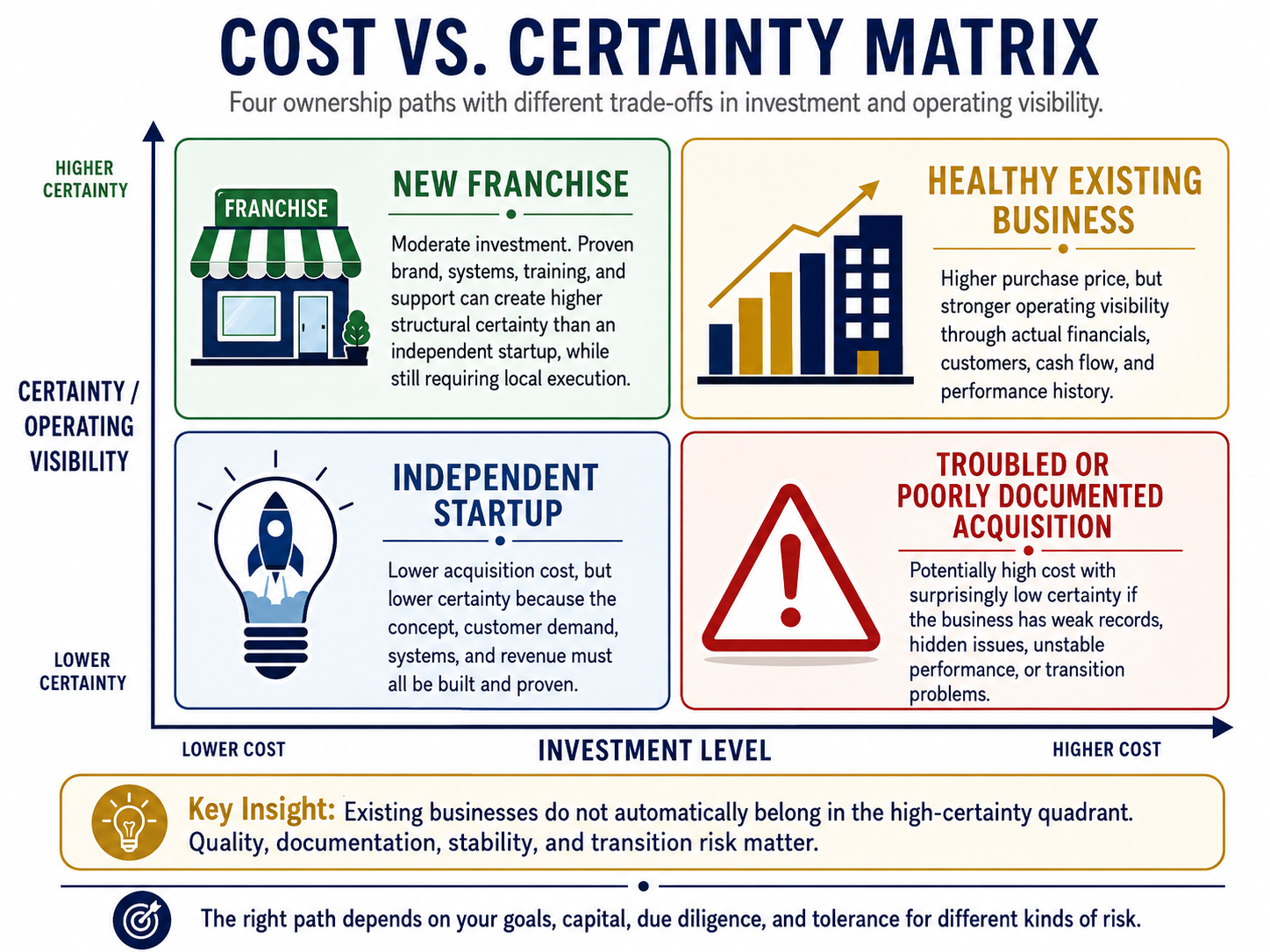
Franchise ownership is a structured, and usually safer and more predictable version of starting from scratch. You are building a new location in a new market, but you are doing it with a proven operating system, a recognized brand, a training program, and a support infrastructure behind you. The franchise model substantially reduces the trial-and-error period that destroys most independent startups, because the critical mistakes have already been made by someone else during the system's development. You are not inventing; you are executing.
The Honest Pros of Starting a Business
Lower entry cost is the most obvious advantage. Buying a profitable existing business always carries a premium for the goodwill and proven performance the seller has built. Starting from scratch eliminates that premium. You pay for assets, not for historical earnings. And when you choose the franchise path, you often enjoy discounts and rebates on equipment, supplies, furnishings, vehicles, and more through negotiated systemwide purchasing agreements.
Creative ownership is real. You build the culture, the brand identity, the customer experience, and the operational approach from the ground up. For entrepreneurs who have a specific vision and the energy to execute it, this is deeply satisfying.
Clean slate operations mean you inherit no hidden liabilities, no legacy systems that need replacing, no inherited staff conflicts, and no prior reputation issues that can surface after the sale closes.
The Honest Cons of Starting a Business
The ramp period is the most underestimated risk in starting from scratch. Most businesses take 12 to 36 months before they generate meaningful owner income. During that period, you are investing capital, time, and energy without a reliable return. The Bureau of Labor Statistics reports that approximately 20% of new businesses fail within the first year and roughly 50% fail within five years.
Revenue uncertainty is significant. You are projecting what a business will earn without the evidence of what it has actually earned. Projections are useful but they are not proof.
The learning curve is steep and expensive. Every system, process, supplier relationship, and customer acquisition channel has to be built from experience, which means mistakes are inevitable and each one costs you time and money you may not have in the early months. Choosing the franchise path can lessen this learning curve burden as comprehensive training is provided as part of the investment.
Buying an Existing Business: What It Actually Looks Like
Acquiring an existing business means purchasing an operation that is already generating revenue, has an established customer base, functioning systems, trained staff, and in most cases, a documented financial history that allows you to evaluate what you are buying before you commit.
In a franchise context, this typically means acquiring a resale from an existing franchisee who is exiting the system. The brand, the territory, the operational infrastructure, and the customer relationships are already in place. You are stepping into a running business on day one rather than building toward one.
According to business acquisition advocate Codie Sanchez, "Wealth doesn't require invention, just action. You don't have to invent the next big thing. You just need to take action on proven models."
The Honest Pros of Buying an Existing Business
Day-one cash flow is the single greatest advantage of acquiring an established business. You are not waiting 18 months to know whether the model works in this market. The evidence already exists in the financial statements.
Reduced uncertainty is the corresponding benefit. A business with three to five years of documented financial history gives you the ability to evaluate actual performance, real customer retention, genuine operating costs, and authentic owner earnings before you sign anything. A professional valuation converts that history into a fair market price. You are making a decision based on evidence, not projection.
Existing infrastructure means trained staff, established supplier relationships, existing marketing presence, and operational systems that do not need to be invented. The ramp period is fundamentally shorter and less capital-intensive than a greenfield start.
Lender confidence is meaningfully higher for acquisitions of businesses with documented positive cash flow. SBA lenders, who are among the most accessible financing sources for small business acquisitions, prefer lending against proven earnings rather than projected ones. A business generating $150,000 in annual seller's discretionary earnings with a clean financial history is far easier to finance than a new business with a compelling projection.
The Honest Cons of Buying an Existing Business
Higher entry cost is the most straightforward drawback. You are paying a multiple of earnings for the goodwill the seller has built. A business generating $150,000 in SDE in the senior care space, for example, might be priced at 2.75 to 3.25 times earnings, meaning an acquisition price in the $400,000 to $490,000 range before financing costs.
Inherited problems are real and can be significant. Staff culture issues, deferred maintenance, customer service problems, or reputation damage from the prior owner's decisions do not always surface in due diligence. They surface after closing. This is why thorough due diligence, professional financial review, and an experienced business broker are not optional steps in the acquisition process.
Seller motivation requires scrutiny. Why is this owner selling? The honest answer matters enormously. Retirement, health, partnership dissolution, and lifestyle change are legitimate and common reasons that do not necessarily indicate problems with the business. Declining revenue, changing market conditions, and rising competition are different categories of seller motivation that should inform your price and your terms.
The Framework for Making the Decision
The right question is not which option is objectively better. It is which option is right for you given your specific circumstances.
If you have limited capital, a long runway, a high tolerance for uncertainty, and a specific vision you want to execute, starting from scratch or entering a new franchise may be the stronger path. The lower entry cost and creative freedom are real advantages for the right person.
If you have sufficient capital to pay an acquisition premium, a shorter timeline to positive cash flow, a lower appetite for startup uncertainty, and the operational experience to step into a running business and improve it, acquiring an existing business with a documented earnings history is often the lower-risk, faster-return path.
The common denominator in either case is the quality of information you have before you commit. A professionally conducted valuation of an acquisition target, a rigorous review of the FDD for a new franchise, honest validation conversations with existing owners, and an advisor who understands both paths are not luxuries in this process. They are the minimum standard for making a decision that deserves to go right.
The Conclusion
Starting a business and buying an existing one are both legitimate paths to ownership. The one that is right for you is the one that aligns with your capital, your timeline, your strengths, and your goals. The one that is wrong for you is the one you chose without adequate information, proper guidance, or honest self-assessment.
I work with people on both sides of this decision every day, and I help with both. Whether you are considering a new franchise, acquiring an existing one, or purchasing an independent business, the first conversation costs you nothing and tells you more than hours of research on your own.
Multiple times every week I talk with aspiring business owners about the best path forward. Independent startup? Franchise startup? Existing business acquisition? We then devise a plan for how I can assist them with any of these three options.
Will Huffhine is a business ownership strategist and founder of Quantum Franchise Group. He works with professionals exploring franchise ownership, business acquisition and entrepreneurship and leads a national team of franchise consultants.