What Skills Do You Need to Become a Successful Business Owner?
The business you choose doesn’t just determine what you earn, it dictates the problems you solve, the skills you build, and the owner you eventually become. Chris Tucker breaks down the "hidden curriculum" of business ownership and how to choose an asset that fits your future.
The business you choose doesn’t just determine what you can earn.
It determines the skills you’ll practice, the problems you’ll solve, and the kind of owner you’ll need to become.
Who Will This Business Require You To Become?
Successful business owners don’t necessarily need a background in corporate finance or deep technical industry expertise. Depending on the business model you choose, ownership may instead demand that you become exceptionally skilled at enterprise sales, talent acquisition, frontline leadership, operational cadence, local marketing, or executive manager development.
That is why one of the most critical questions to ask before acquiring a business is not simply, “Can this business make money?” It is: What will owning this business repeatedly require me to become good at, and do I actually want to develop those specific skills?
I think of this dynamic as the hidden curriculum of business ownership—an unwritten set of capabilities every business model teaches its owner through the work that must be performed repeatedly day after day.
What Is the Hidden Curriculum of Business Ownership?
The hidden curriculum of business ownership is the specific set of capabilities an owner builds by repeatedly solving the operational problems inherent in a particular business model.
For example, a relationship-driven B2B service company requires its owner to master consultative selling, pipeline management, and account retention.
A decentralized field-service business demands proficiency in technician recruiting, route optimization, process discipline, and frontline leadership.
Meanwhile, a consumer-facing retail model requires mastery of local brand positioning, labor utilization, and developing middle managers.
All three can represent exceptionally profitable enterprises, but they are actively training their owners to pay attention to entirely different things. Evaluating a business solely by top-line revenue, margins, or projected ROI provides a dangerously incomplete picture of what your daily life as an owner will actually feel like.
What Job Are You Creating for Yourself?
To understand how easily this hidden curriculum can catch an owner off guard, consider a skilled trade professional I’ll call Chuck. Chuck is extraordinary at his craft, and after years of working for someone else, he buys a vehicle, acquires commercial tools, forms an LLC, and starts working for himself.
Technically, Chuck has achieved economic ownership, but his daily work hasn't changed very much. He is still estimating jobs, answering client calls, troubleshooting operational fires, and executing the physical trade—except now he has added payroll, insurance, collections, and scheduling to his workload.
Chuck didn’t necessarily make a bad decision, but he overlooked an essential question:
What job am I actually creating for myself on Day One?
Just as importantly, he failed to ask:
If the business succeeds, what must my job eventually become?
If Chuck’s enterprise grows from a single truck to several crews, the business will stop needing him to be its best technician. It will demand that he recruit talent, develop general managers, monitor financial KPIs, allocate capital, and build repeatable processes.
The technical skills that get someone into a business are rarely the capabilities required to scale it beyond their personal labor.
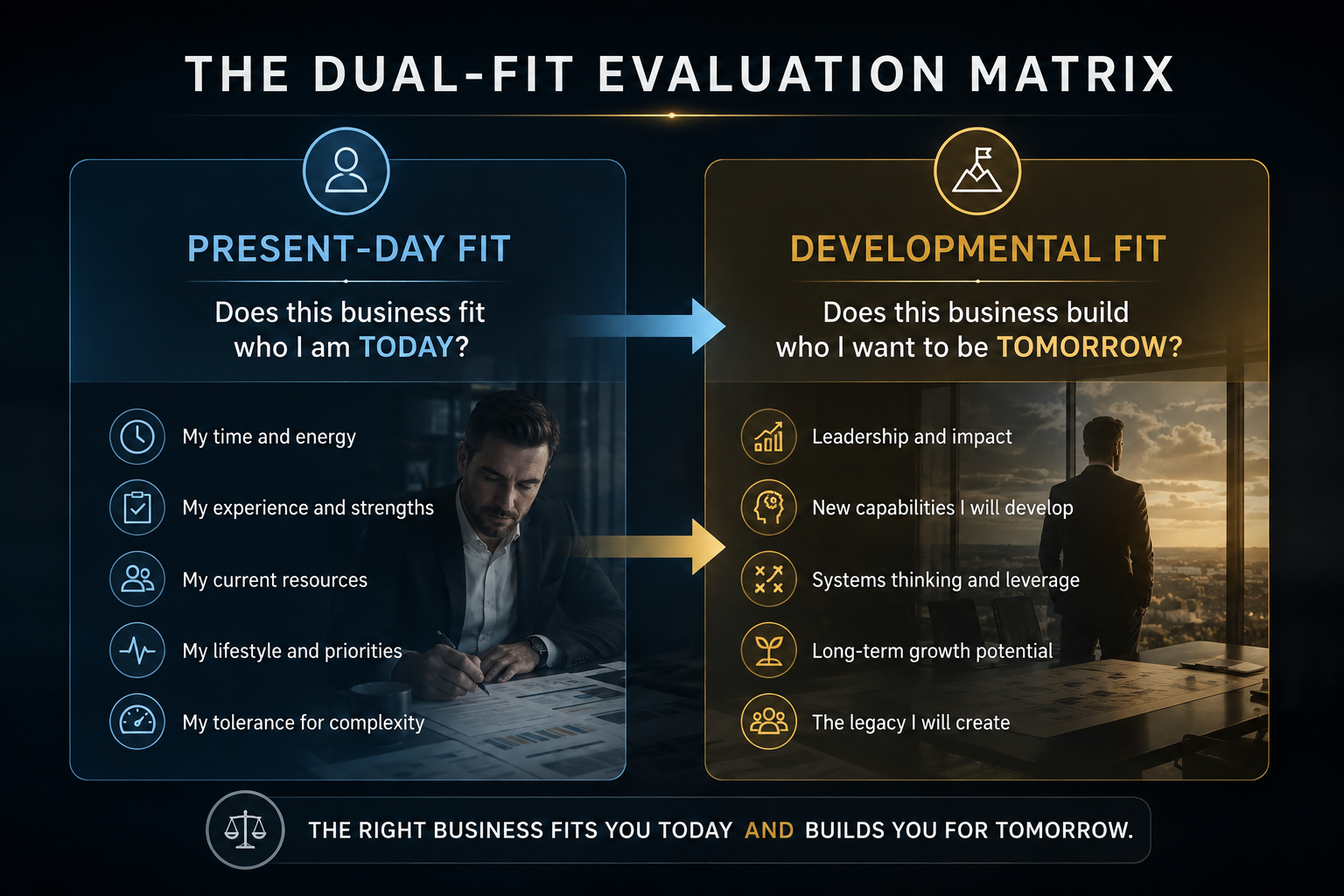
Present-Day Fit vs. Developmental Fit
When I advise accomplished leaders evaluating business ownership, I analyze fit across two distinct dimensions.
The first is Present-Day Fit: Does this business model reasonably align with your existing strengths, leadership style, risk tolerance, and career experience?
The second, and far more overlooked, is Developmental Fit: Do you actually want to evolve into the specific kind of owner this business will require three to five years down the road?
Imagine two acquisition opportunities with matching investment requirements and financial projections on paper. One requires the owner to cultivate sophisticated B2B enterprise sales and relationship-building capabilities. The other demands that the owner become exceptional at high-volume recruiting, field labor management, and operational process design.
Their economics might look identical on a spreadsheet, but the lived experience of owning them will be completely different. A thorough evaluation must consider not only what the business can financially produce, but what it will repeatedly require its owner to execute.
What I Learned From Owning a Franchise
I did not fully appreciate this distinction when I acquired my own franchise years ago. I entered a boutique wellness business with a deep emotional connection to its mission, and I valued the documented playbooks, central technology, and brand support that came with the platform.
Ownership taught me an extraordinary amount. I mastered local marketing, site selection, labor utilization, and the heavy responsibility of leading a team whose livelihoods depended on my strategic decisions.
However, if I could sit across the table from my former self during due diligence, I would insist on adding one critical question to my evaluation matrix:
What will becoming excellent at owning this specific business require me to become excellent at doing, and do I actually want to organize the next chapter of my professional life around mastering those skills?
That doesn't mean prospective owners should seek out businesses that feel completely comfortable today. Good businesses naturally stretch their owners. But there is a massive difference between a productive stretch that builds capabilities you value, and chronic operational friction caused by spending years doing work you fundamentally dislike.
What Would Your Role Look Like Five Years From Now?
Before signing an agreement, project yourself five years into a highly successful execution of the model. Top-line revenue has scaled, employees have joined the team, management layers are in place, and organizational complexity has increased.
Now, picture an ordinary Tuesday morning three years down the road: What are you actually doing at 9:00 AM?
Are you developing strategic enterprise partnerships, managing unit directors, reviewing operational metrics, building recruiting pipelines, coaching a sales team, or allocating capital into new expansion territories? Once that picture is clear, ask yourself one final question:
Do I genuinely want to become exceptionally good at those specific responsibilities?
Most ambitious professionals evaluate businesses based on what ownership might eventually provide: income, equity growth, calendar autonomy, status, or generational wealth.
But every business charges a daily tuition before delivering those end-state outcomes. It teaches its owner how to solve certain problems, lead certain teams, build certain systems, and pay attention to certain operational levers. That is the hidden curriculum of business ownership.
Before you buy a business, don’t just ask what it could eventually produce. Ask what owning it will repeatedly require you to become good at, and whether that is the owner you actually want to become.
As a franchise consultant and business ownership advisor I regularly speak with people who are planning a new future as a business owner. I have the perspective of someone who has walked that path and learned both good and bad circumstances. I'd welcome an opportunity to help you think through your ideal future.
Sign up for Business Builder Magazine
A magazine, published by Quantum Franchise Group, for new and aspiring business owners in the United States.
Chris Tucker created The Corporate Refugee® and an ownership advisory methodology that helps professionals determine what they should build before deciding what they should buy. Franchise selection is one possible downstream application.