🎧 The Practitioner Paradox: What Happens When Your Expertise Outgrows Your Capacity?
When technical mastery becomes a growth ceiling, you face a choice: remain a time-constrained technician or evolve into an owner. The key is building a system that allows your hard-earned expertise to scale without burning you out.
When your expertise outgrows your capacity, technical mastery transforms from a career engine into a growth ceiling, forcing a choice between remaining a time-constrained technician or evolving into a business owner.
This article explores why exceptional practitioners inevitably hit this limit, the critical distinction between mastering a craft and building an enterprise, and how leveraging turnkey operational infrastructure allows veterans to transition from direct service delivery to leading manager-led organizations that scale their expertise without burning out.
The Capacity Ceiling
Early in a career, progress is straightforward: hone your craft, build a reputation, fill your calendar, and increase your income. But eventually, every hands-on professional hits a fundamental physical wall. There are only so many hours you can work in a week and, in physical or high-touch professions, only so much labor your body can perform before fatigue sets in.
This is The Practitioner Paradox: the tipping point where the mastery that created your success limits your capacity because revenue depends entirely on your personal, hourly production. Raising prices can temporarily improve unit economics, but it fails to fix the structural issue. If every dollar requires your physical presence, you haven't built an enterprise—you have built a demanding job.
Download a free copy of the Quantum Franchise Group publication, Why the Franchise Model is Exploding in the United States.
Mastering a technical skill and building a scalable business require entirely different capabilities. Having owned a boutique wellness studio managing dozens of therapists, I saw this dynamic constantly.
Many professionals deeply understand client care, service nuances, and employee retention. However, domain skills do not automatically prepare someone to negotiate commercial leases, analyze balance sheets, execute digital marketing, or lead an organization.
For some, remaining focused purely on the craft is the right decision. But for those constrained by their personal physical ceiling, the paradox creates an opportunity to deploy hard-earned expertise through an operational vehicle rather than manual labor.
Infrastructure Around the Expert
Consider how an insider solves this challenge. An emerging wellness franchise founder I’ve analyzed began as a solo practitioner, added treatment rooms, hired staff, and eventually franchised her model.
She repeatedly encountered skilled therapists who wanted ownership but lacked surrounding business infrastructure: real estate selection, marketing engines, operating systems, and financial modeling. Rather than teaching experienced technicians how to perform their core job better, the system provided a turnkey operational foundation.
A strong franchise acts as a capability-transfer platform. It packages proven solutions to complex business problems so a new owner does not have to discover every answer through trial and error.
Evolving the Role
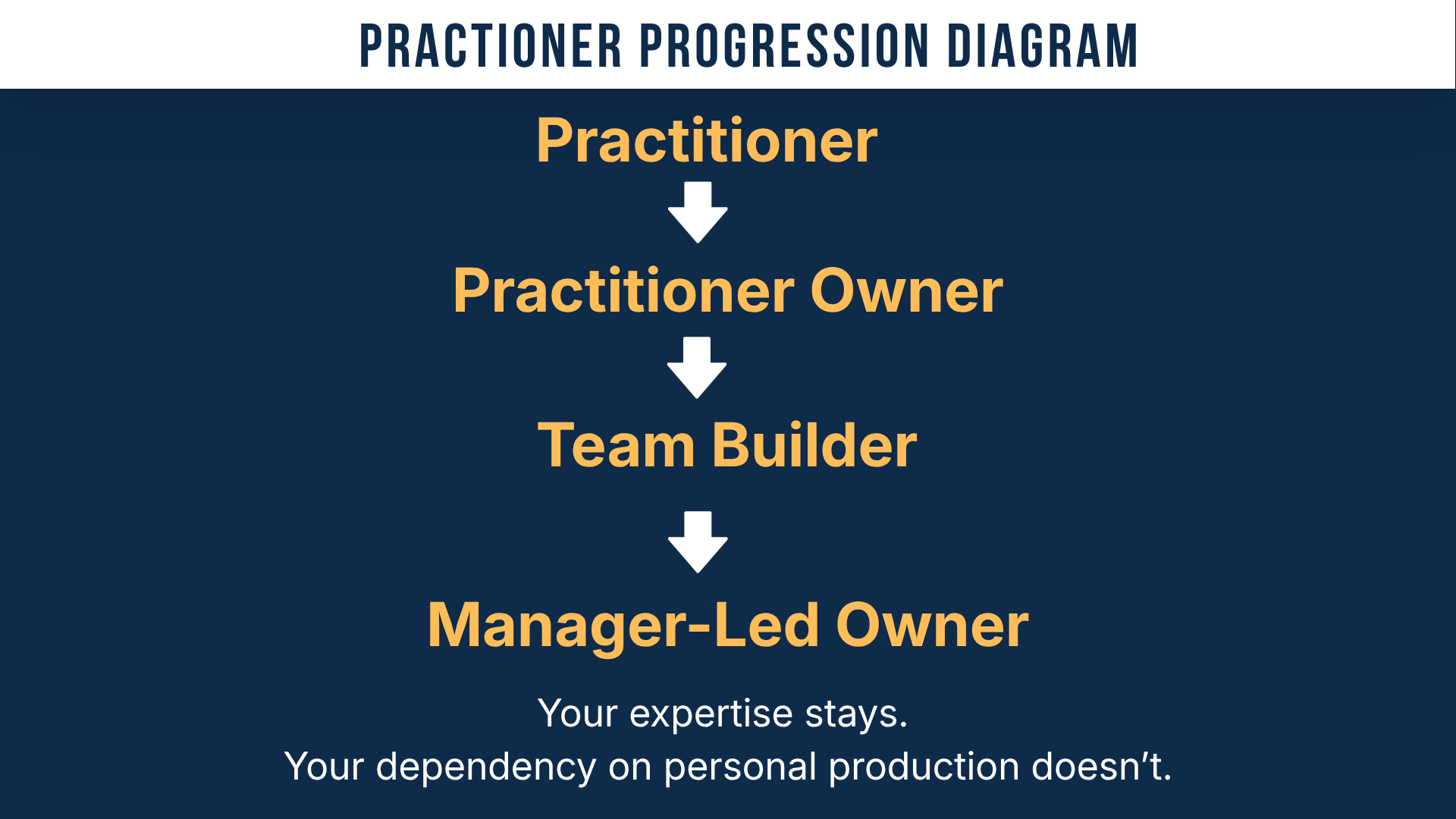
This transition does not require an abrupt leap from service delivery to corporate manager; it allows for structured evolution.
One veteran therapist spent 20 years at the table before launching a small-footprint suite model. Initially, she continued performing treatments while learning local operations. As revenue stabilized, she expanded into a multi-room facility, hired staff, and systematically stepped back from daily appointments:
She still treats clients occasionally because she enjoys it, but service delivery has become a voluntary choice rather than a financial requirement.
Shifting Capacity
Transitioning from technician to owner changes where capacity originates:
Craft: Personal labor creates linear value.
Leadership: Developing staff multiplies value.
Systems: Standardized processes allow quality to scale.
Ownership: The organization creates value independently of your time.
Before making this leap, ask yourself: Would I derive fulfillment from mentoring others? Am I willing to take responsibility for financial performance? Do I want my income tied to my personal labor or to an asset I own?
Leveraging Your Experience
After decades in a field, accumulated judgment does not disappear when stepping away from daily production—it becomes far more valuable.
The practitioner who understands employee burnout can build an environment that attracts top talent. Years of operational intuition can be embedded into systems and culture rather than spent one client at a time.
That is the hidden opportunity inside the Practitioner Paradox: when personal capacity hits its limit, the next chapter isn't working harder, it's building a system that allows your expertise to scale.
Chris Tucker is a certified franchise consultant and former multi-unit franchise owner. He helps people evaluate business ownership the perspective of a trained consultant and practitioner. Schedule a call with Chris to discuss your goals and how he may be able to assist you at no cost to you.
Chris Tucker created The Corporate Refugee® and an ownership advisory methodology that helps professionals determine what they should build before deciding what they should buy. Franchise selection is one possible downstream application.