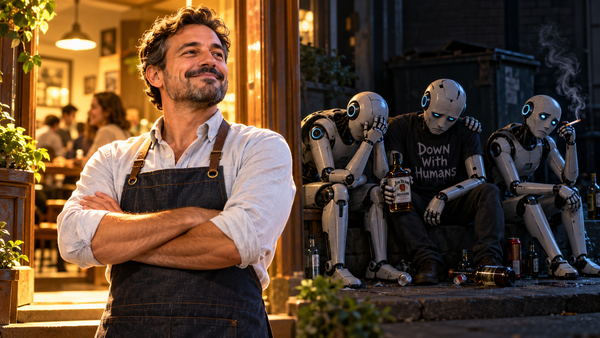
The businesses hardest for artificial intelligence to disrupt share three core characteristics:
They require physical presence in unpredictable environments, they depend on human trust built over time, and they involve judgment that cannot be reduced to pattern recognition.
Research from McKinsey Global Institute and a 6,000-person survey conducted by OnePoll for ServiceForge in early 2026 consistently identify skilled trades, in-home care, mental health services, and trust-based advisory roles as the categories most resistant to AI automation.
That finding matters for anyone evaluating business ownership today, because it points toward opportunity rather than anxiety.
AI is genuinely remarkable. It writes code, drafts legal briefs, summarizes financial reports, and generates marketing content at a speed and scale that would have been unimaginable five years ago. The disruption is real, and anyone who tells you otherwise is selling something. But disruption has limits, and understanding where those limits fall is not just academic. It is the most practical question a would-be business owner can ask right now.
Consumer Sentiment · AI vs. Human Service
What Consumers Really Think About AI in Service Businesses
Share of adults who agree — ServiceForge/OnePoll survey, n = 6,000 U.S. adults, 2026
87%
Prefer a real person when calling a home service
73%
More loyal to businesses that use people over AI
62%
Don’t trust AI to handle a service emergency
The Problem AI Cannot Solve: You Have to Be There
Start with the most obvious constraint. A pipe doesn’t care how sophisticated your AI system is. When water is coming through the ceiling at 11 p.m., someone has to show up with tools and training and fix it. No algorithm does that. No chatbot patches a burst line.
McKinsey Global Institute has long identified “unpredictable physical environments” as one of the primary barriers to automation. Construction sites, residential homes, commercial kitchens, human bodies: these are settings where conditions change from job to job, and where the ability to adapt in real time is the entire value proposition. Electricians, HVAC technicians, plumbers, auto mechanics, landscapers, and cleaning professionals work in those environments every day. Their training cannot be uploaded to a server and deployed at scale. You still need a person with a truck.
This is not a temporary gap waiting to be closed. Robotics capable of navigating unstructured physical environments the way a skilled tradesperson can remain enormously expensive and limited in scope. The Upwork research team, tracking labor market shifts, places skilled trades at the top of its list of roles AI is least likely to replace, for precisely this reason.
The Problem AI Cannot Solve: People Want People
The data on consumer sentiment here is striking, and it runs counter to the technology industry’s preferred narrative. A 2026 survey of 6,000 adults conducted by OnePoll for ServiceForge found that 87 percent of respondents would rather speak with a real person than an AI system when contacting a local home service provider. Four out of five said they would actively choose a business where a human answers the phone over one that routes them to automation. Seventy-three percent said they would be more loyal to companies that rely on people rather than AI for customer service.
Think about what that means for a franchise owner or an independent service business. The competitive advantage is not a better algorithm. It is the fact that you pick up the phone. As ServiceForge’s Jane Blanchard put it: “The companies that earn long-term loyalty are those that use technology to enhance human service, not replace it.”
The preference for human contact intensifies in high-stakes situations. Sixty-two percent of survey respondents said they do not trust AI to take the correct action in a home service emergency. Seventy-one percent believe human representatives show more empathy. When something goes wrong in someone’s home or business, they do not want a chatbot. They want a professional who understands the stakes.
The Problem AI Cannot Solve: Trust Takes Time
Beyond the physical and the emotional is something harder to name but easy to recognize. Certain professions run on relationships that have been tested over years, and those relationships cannot be replicated by a tool that appeared on the internet last Tuesday.
Mental health therapists are a clear example. The therapeutic relationship itself is the mechanism of healing. Cognitive behavioral therapy does not work in the abstract. It works because a specific person learns your history, earns your confidence, and walks with you through hard things. As Upwork notes, the empathy, presence, and relational depth that mental health professionals provide remain outside what AI systems can authentically offer.
The same principle holds for financial advisors, estate attorneys, life insurance professionals, and yes, franchise consultants. When someone is making a decision that involves their retirement savings, their family’s future, or the business they plan to build their next chapter around, they want to talk to a person who will be accountable to them over time. An AI tool can gather data and run projections. It cannot sit across the table from you, understand your risk tolerance, know your marriage, and help you make a decision you can live with.
That is not a knock on AI. It is a statement about what trust actually requires.
💡
Many of the franchise categories experiencing the strongest growth right now sit squarely in AI-resistant territory.
What This Means If You’re Evaluating a Business
According to WTOP’s analysis, the business categories that show the most consistent AI resistance share a recognizable profile: physical work that varies by location and situation, services tied to an aging and growing population, and relationships built on accountability over time. Home health, childcare, elder care, skilled trades, mental health, and personalized professional services all fit that profile.
For anyone exploring franchise ownership, this is not a coincidence. Many of the franchise categories experiencing the strongest growth right now sit squarely in AI-resistant territory. Brands built around in-home services, health and wellness, personal care, and senior services are expanding precisely because demographic demand is rising and no technology is positioned to take that market from them.
The question I encourage every candidate to ask is not whether AI will affect a given industry. It will affect every industry. The right question is whether the core value that business delivers, the reason a customer reaches for their phone at 11 p.m. or walks through that front door, depends on a human being. If the answer is yes, you are looking at a business with structural staying power.
Not every business passes that test. But the ones that do are worth your attention.
Download the free Quantum Franchise Group publication, "Why the Franchise Model is Expanding in the United States."
Instant Download
Sign up for Business Builder Magazine
A magazine, published by Quantum Franchise Group, for new and aspiring business owners in the United States.
No spam. Unsubscribe anytime.