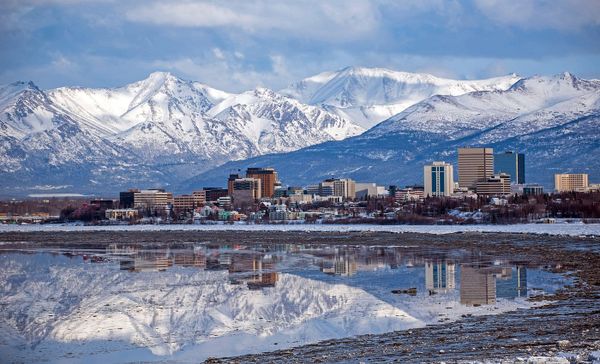
Anchorage gets 5 hours and 27 minutes of daylight at the winter solstice, and its outdoor pickleball courts at Chester Creek are open only from May 1 through September 30. Every one of the 13 indoor places to play in the city is a shared school gym, rec center, or health club with no dedicated commercial club anywhere in the municipality. That is the shape of this market in one fact: real, documented, year-round demand sitting in categories nobody has built for.
Why this city
Anchorage is not a growth story and should not be underwritten as one. The city peaked at 302,127 residents in 2013, has posted negative net migration in 15 of the last 16 years, lost 1,309 net residents in 2024-25, and watched its working-age population fall 8.9 percent over the last decade. Births are down 29 percent since 2010-11 while deaths are up 53 percent, and federal government employment fell 8.4 percent in the first half of 2026.
What makes it interesting is the money and the friction. Median household income is $103,284, more than half of households clear $100,000, and 19,706 households clear $200,000, in a state with no individual income tax and no general sales tax.
The friction is severe: industrial vacancy was reported below 1 percent, commercial electricity runs about 75 percent above the national average, freight fuel surcharges are running 18.5 to 26.5 percent, and the cost of living index sits at 127.9.
Anchorage rewards businesses that solve an expensive, seasonal, recurring problem and punishes anything that competes on volume and price.
Idea 1: A heated winter vehicle preservation shop
The customer is one of roughly 65,849 households running two or more vehicles, plus fleets that cannot afford downtime. The menu is narrow on purpose: corrosion protection, studded tire changeover and off-season storage on the state's September 16 through April 30 cycle, fluid and cooling service, and block heater work, all booked indoors.
Capacity is visibly oversubscribed, with documented 2 to 4 week mechanical waits, 6 week dealer waits, and 2.5 to 3 month body shop backlogs, while only two dedicated undercoating providers operate here and Christian Brothers, AAMCO, Firestone, and Les Schwab are absent statewide.
Budget $610,000 to $1.4 million.
The top risk is real estate, since sub-1-percent industrial vacancy means bidding for heated bays against logistics tenants.
Idea 2: A dual-track residential and commercial cleaning company
The customer is two customers: the high-income household buying recurring maid service on a tight route, and the property manager, small office, or public agency buying contract janitorial on a monthly scope.
This is the cleanest documented absence in the market. Molly Maid, The Cleaning Authority, MaidPro, and Two Maids all publish location lists that omit Anchorage, the Merry Maids office here is listed as closed, City Wide shows an Alaska heading with no locations, and Jan-Pro names Anchorage as an open developer territory, all while six public janitorial solicitations were active.
Budget $95,000 to $260,000, the cheapest of the three to test.
The top risk is labor, since the same working-age decline that thins competitors thins your hiring pool.
Idea 3: A dedicated indoor pickleball and racquet club
The customer already plays, in a shared gym or on a seasonal outdoor court, and will pay for a guaranteed slot, leagues, lessons, and warmth.
The fit rests on documented absence: The Picklr returns no locations in the area, Chicken N Pickle enumerates its markets with no Alaska entry, and every indoor court here is shared use, in a state where outdoor recreation is 5.3 percent of GDP, the highest share nationally.
Budget $3.9 million to $6.8 million, and only inside an existing large shell such as North Pointe at 3101 Penland Parkway.
The top risk is an unproven format against unforgiving fixed cost, and Shockwave Trampoline Park lost its lease at that same property.
What to avoid
Seven categories in Anchorage are already full, and the evidence is not close. Beauty and spa carries roughly 110 med spas, 72 barber shops, and 89 hairdressers.
General fitness shows 67 to 91 listed gyms with two documented closures, including Planet Fitness at Northway closing indefinitely.
Painting returns 301 contractors near Anchorage, the densest field in the city, which is worth remembering the next time a franchisor markets Anchorage as an open territory.
Print and mailing is covered by five UPS Store units, two FedEx Office units, Minuteman Press, and PIP against a flat retail employment base.
Ice sports is oversupplied and politically distorted, with six sheets, UAA publishing open ice time, $3.336 million in annual municipal arena contracts, and an active dispute costing taxpayers thousands a day.
Heavy freight is a capital wall held by Lynden, Carlile, Span Alaska, Northern Air Cargo, Everts, and Alaska Marine Lines, and HVAC and plumbing shows 137 heating contractors with multi-decade incumbents.
One thing to price before signing anything
An open franchise territory is not a demand signal, and Anchorage proves it twice over. CertaPro lists Anchorage as available in the single most saturated category in the city, and Koala Insulation lists it as available even though the state housing agency currently says no retrofit rebates are available and the federal weatherization money routes through three named nonprofits.
Price the space and the labor before you price the opportunity, because in this market the lease terms, the electricity bill, the freight surcharge, and the shrinking hiring pool decide the outcome long before demand does.
Sign up for Business Builder Magazine
A magazine, published by Quantum Franchise Group, for new and aspiring business owners in the United States.
No spam. Unsubscribe anytime.